
Women's Care, Cancer
Mammography 101: Mammograms, self-exams and when to start
Key Takeaways:
- Breast cancer is the most common cancer in women after skin cancer.
- To help prevent or find breast cancer early, know your family history, do monthly breast self-exams and start screening mammography at the age recommended for you.
- A mammogram is a radiographic image of the breast at different views to detect and evaluate breast changes.
- You can also detect changes to your breasts, such as lumps or pain, by doing monthly breast self-exams.
- St. Joseph’s/Candler offers 3D mammography at five locations, in addition to the Mobile Mammography Unit.
Almost all of us know someone who’s had breast cancer.
It’s the most common cancer in women in the United States after skin cancer, and it accounts for about one in three new cancers in women each year, according to the American Cancer Society.
So what can you do about it?
- Know your family history
- Do your monthly self-exams
- Start mammography screening at the age recommended for you, which most commonly is 40 years old
“Mammography is still the gold standard for detecting breast cancer,” says Pattie Barnes, staff mammographer at St. Joseph’s Hospital. “Even if you don’t have a family history, even if you don’t have dense breasts, come for your screening mammogram when age appropriate because it is so vitally important."
Why early detection matters for breast cancer
Breast cancer is cancer that starts in the cells in the breast. The ducts and lobules are the two parts of the breast where cancer is most likely to start.
Once breast cancer forms, cancer cells can spread to other parts of the body, or metastasize, making it more life-threatening.
The good news is that breast cancer is often found early, when it’s small and before it has spread. That’s thanks to self-exams and mammograms. Additional imaging may be needed such as breast ultrasound or MRI.
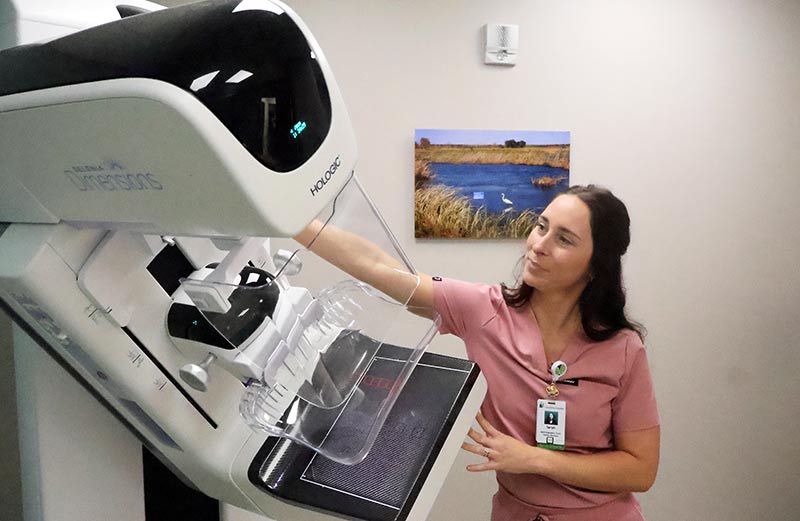
What is a mammogram and why is it important for detection?
A mammogram is radiographic imaging of the breast at different views to detect and evaluate breast changes. St. Joseph’s/Candler imaging services offers 3D digital mammograms for screening and diagnostic purposes.
A mammography machine is designed to look at breast tissue. The machine has two plates that compress or flatten the breast to spread the breast tissue allowing for a better image of the breast but with less radiation used.
During a screening mammogram, the machine provides two views of each breast, Barnes says. The CC View, or cranial caudal, comes down from the top (cranial) all the way down to the caudal (meaning feet). The second view is called MLO, or mediolateral-oblique, and comes from the side at an angle.
All mammograms at St. Joseph’s/Candler are digital, therefore, images can be manipulated to enhance quality. Digital mammography is especially effective in women with dense breasts, which can be inherited and is common in younger women who haven’t gone through menopause.
Whether it’s your first mammogram or you’ve had a few, understanding the process is important. Learn more about what to expect at your mammogram appointment to have a positive experience.
What are the benefits of 3D mammograms?
While utilizing the latest technology for mammography is an obvious advantage, there are several other benefits in store for patients who want to have a 3D mammogram done by SJ/C:
- Clearer images of dense breast tissue. Viewing tissue in thin layers makes it easier to see through overlapping structures, which is especially helpful for women with dense breasts.
- Earlier detection. Seeing the breast in greater detail can help radiologists identify small abnormalities that may be harder to spot on a 2D image.
- Fewer false alarms. Because overlapping tissue is less likely to mimic a concern, 3D mammography can reduce the number of women called back for additional imaging.
- More precise location of abnormalities. Layered images help pinpoint the size, shape, and location of an area of concern.
- Same quick, familiar experience. The exam takes about the same amount of time as a standard mammogram, and the compression feels similar.
- Low radiation dose. The radiation exposure is low and within FDA-regulated safety limits.
If you need a mammography, make it 3D. Learn more about this amazing imaging technology available at St. Joseph’s/Candler today.
When should I start getting mammograms?
Yearly breast cancer screening mammograms are recommended starting at age 40, unless you have a family history. If, for example, your mother was diagnosed with breast cancer at 45, you should start screening 10 years prior, at age 35.
“I know people have that stigma in their mind that it hurts or it’s painful, but we are finding things – three, four, five milliliters – on mammograms that we never found before,” Barnes says. “We are keeping patients from having huge lumpectomies, and we are finding it before it can spread.”
Women who are at a higher-risk of breast cancer, such as those with a family history, dense breast or carry the BRCA gene, may need more imaging. For example, some women with dense breast may rotate between mammogram and six months later ultrasound.
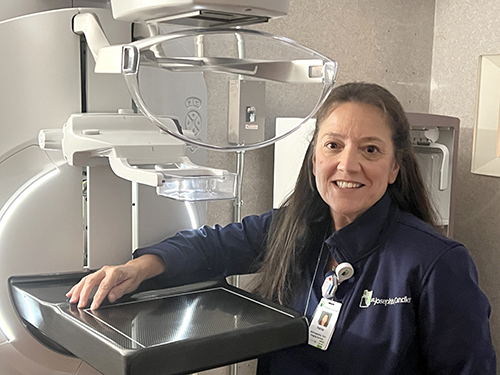
How to do a breast self-exam?
While mammograms are the gold standard in detecting breast cancer, some breast cancers are first found through physical exams, whether by yourself or a primary care doctor or OB/GYN.
That’s why it’s also important for you to know how your breasts normally look and feel. You can learn this and detect changes with monthly breast self-exams, which are recommended for all women – and men too.
By becoming familiar with the look and feel of your breasts, you can quickly identify any changes, such as lumps, pain or skin abnormalities. Detecting these changes early increases the chances of identifying potential issues, whether benign or cancerous, at an early, more treatable stage.
If you notice any changes to your breast, call your healthcare provider right away.
What kind of doctor do I need to see to get a mammogram?
You don't need a specialist to get a mammogram. Most women start with a doctor they already see, and the process is simpler than many people expect.
Your primary care provider or OB-GYN is usually the best place to start. They can talk with you about when to begin screening, how often to come in and whether your personal or family history means you should start earlier or have additional imaging. They can also place the order for your mammogram and help with getting a referral to an imaging center like St. Joseph's/Candler.
Where can I get a mammogram at St. Joseph’s/Candler?
If you need a mammogram or the next time your annual screening comes up, St. Joseph’s/Candler has several convenient locations to schedule your appointment. At St. Joseph’s/Candler, all mammography locations are equipped with state-of-the-art 3D digital mammography technology.
Our screening mammogram locations are:
Telfair Pavilion
5353 Reynolds Street (First floor at Candler Hospital)
Savannah, Ga. 31405
912-819-7000
Telfair Breast Imaging Center – Eisenhower
527 Eisenhower Drive
Savannah, Ga. 31406
912-691-1460
St. Joseph’s Hospital Imaging
11705 Mercy Blvd.
Savannah, Ga. 31419
912-819-2452
SJ/C Imaging Center – Pooler
101 St. Joseph’s/Candler Drive
Pooler, Ga. 31322
912-748-0068
SJ/C Imaging Center – Bluffton
10-A Oak Forest Road
Bluffton, SC 29910
843-836-4300
Call any of the locations above to schedule you next mammogram. Established St. Joseph’s/Candler patients also can book a mammogram online through the patient portal – just look under appointments. If you are seeking a diagnostic mammogram, please call 912-819-6800.
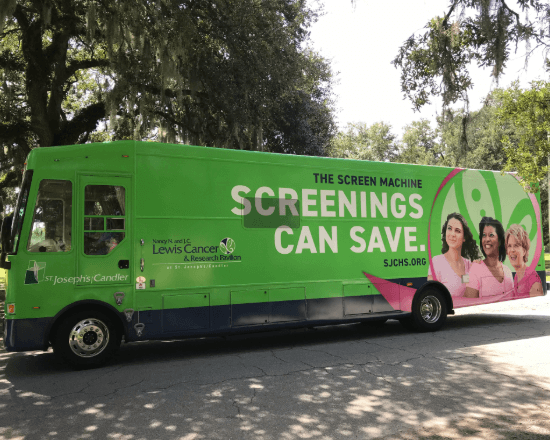
St. Joseph’s/Candler Mobile Mammography unit
St. Joseph’s/Candler also offers its Mobile Mammography Unit, the “Screen Machine,” to women in Savannah and the outlying rural areas. The mammography unit accepts most insurance plans. Financial assistance is available for women who are at least 40-years-old, uninsured and meet certain financial qualifications.
Having a mammogram on the Screen Machine is safe and confidential and offers the same level of care provided at any of our imaging locations.
Visit our events page for a schedule of upcoming Mobile Mammography Unit locations or call 912-819-6800 to schedule an appointment.
What if I need follow-up?
If your screening mammogram shows something that needs a closer look, you may be asked to come back for a diagnostic mammogram or other imaging, such as a breast ultrasound. Being called back is common, and most of the time it does not mean cancer. If further testing or treatment is needed, you may be referred to a breast specialist or breast surgeon, and our multidisciplinary team works together to plan your care.
What if my mammography detects breast cancer?
If screening and then a breast biopsy do reveal you have breast cancer, St. Joseph’s/Candler understands how overwhelming that diagnosis can feel to you and your family. We take a personalized approach to tailor your care to your unique needs.
St. Joseph’s/Candler and the Nancy N. and J.C. Lewis Cancer & Research Pavilion has a team of physicians, nurses, technologists, nutritionist, social workers and more to guide you through every step of your journey. And we back that team of experts with cutting-edge technology.
Mammograms and Mary Telfair: How SJ/C continues an important legacy
St. Joseph's/Candler is committed to helping the women in our local community, and that doesn't stop at mammograms. We are proud to build on Mary Telfair's legacy of prioritizing women's healthcare.
In 1875, just days before her death, Savannah philanthropist Mary Telfair made provision in her will for a hospital dedicated to women. The Telfair Hospital for Females opened in 1886 as the first hospital in Georgia devoted exclusively to women's care. After merging with Candler Hospital in 1960, it grew into what is now Mary Telfair Women's Hospital at Candler, the longest-operating women's hospital in the nation.
That legacy lives on through the Telfair Pavilion and the Telfair Mammography Fund. Part of St. Joseph's/Candler's nationally accredited breast care program, the Telfair Pavilion combines advanced screening and diagnostics with a team truly focused on your well-being while the Telfair Mammography Fund helps to provide financial assistance to uninsured and underinsured women who may have a financial barrier to important healthcare services.
Do you want to also support compassionate, dignified care like Mary Telfair envisioned? Donate today to help the women in our community who need it most.
Not sure if you can afford your mammography? SJ/C can help
Your health shouldn't depend on your ability to pay. If cost or lack of insurance has ever kept you or someone you know from getting a mammogram, you're not alone, and help is available.
The Telfair Mammography Fund provides no-cost breast health services to uninsured and underinsured women in our community. The fund can help cover screening and diagnostic mammograms, breast ultrasounds, breast biopsies, MRIs, surgical costs (where appropriate) and more.
Through the fund and SJ/C’s provider connections, many radiologists, pathologists, and surgeons have also agreed to accept reduced fees for these patients, allowing the fund to reach as many women as possible.
Ready to get started? Apply to the Telfair Mammography Fund today or call the Telfair Mammography Fund hotline at 912-819-7055 to see if you qualify.