
Women's Care, Cancer
Breast Cancer: Screening, Symptoms, and Treatment at St. Joseph's/Candler
Table of Contents
- What is breast cancer and who does it impact
- Why early detection matters
- What kind of breast cancer screenings can St. Joseph’s/Candler provide?
- Additional SJ/C breast cancer services
- Supportive women's health services
- Breast care centers near you
- Be aware of breast cancer risk factors
- Breast cancer symptoms
- Show your support during Paint the Town Pink
- Take the next step: Breast cancer care close to home
Breast cancer is the most commonly diagnosed cancer among women in the U.S. and the most treated cancer at the Nancy N. and J.C. Lewis Cancer & Research Pavilion at St. Joseph's/Candler.
- About 1 in 8 women in the U.S. will be diagnosed with breast cancer in their lifetime.
- When breast cancer is found at a localized stage, the 5-year relative survival rate is around 99%.
- St. Joseph's/Candler offers advanced breast imaging, personalized treatment plans, and a full breast cancer center close to home.
Read on to learn who's at risk, what screening actually involves, and what breast cancer services and support programs are available to you.
What is breast cancer and who does it impact
Breast cancer develops when cells in the breast tissue begin growing uncontrollably, often forming a tumor that can be felt as a lump or seen on a screening mammogram.
While it's most commonly associated with women (about 1 in 8 will be diagnosed in her lifetime), men are also diagnosed with invasive breast cancer each year in the U.S. It can affect people at any age, though risk increases as women get older.
No matter who it affects, breast cancer is highly treatable when it's caught early and managed by an experienced care team. The Lewis Cancer & Research Pavilion brings together specialized physicians, advanced technology, and personalized treatment plans to support every patient through diagnosis and beyond.
Why early breast cancer detection matters
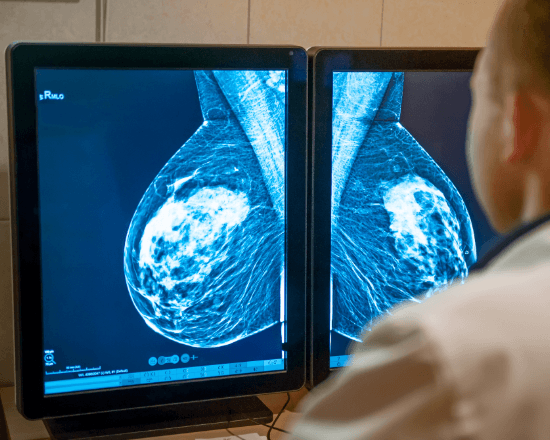
Early detection is, without question, the single biggest factor in breast cancer survival. When breast cancer is caught in its earliest, localized stages, the 5-year relative survival rate is 99% according to the American Cancer Society.
This is exactly why routine mammograms and self-exams matter so much. They often catch the disease before it has a chance to spread, allowing oncologists to have more time and more treatment options.
What kind of breast cancer screenings can St. Joseph’s/Candler provide?
Breast cancer screening typically combines a few key tools your provider uses together to get an overall idea of your breast health, versus relying on one test alone. By utilizing several screenings, paired with St. Joseph’s/Candler’s advanced breast cancer technology, we can improve the accuracy of our results and provide a more thorough assessment for our patients.
St. Joseph’s/Candler breast cancer screenings include:
- Breast self-exam training
- Clinical breast exams
- 3D Mammograms
- Breast Ultrasounds
- Automated Breast Ultrasound Systems (ABUS)
- Computer- Aided Detection (CAD)
- Core Needle Biopsies
- Galactograms
- Needle Localization
- Stereotactic Breast Biopsies
At St. Joseph's/Cander, we provide the most advanced imaging services to our people, especially when it comes to helping those with breast cancer. Learn more about our extensive and state-of-the-art breast cancer detection technologies to discuss with your doctor if they are an option for you.
Additional SJ/C breast cancer services besides screening
If you are diagnosed with breast cancer, St. Joseph's/Candler offers a full continuum of care built around each patient's specific needs — from treatment through recovery and beyond. Explore the full list of SJ/C services, including:
- Nurse navigators
- Personalized treatment plans (chemotherapy, infusions, radiation, targeted therapy and clinical trials)
- Experienced care teams (medical oncologists, radiation oncologists, surgeons, radiologists and more)
- Breast cancer surgery (including lumpectomies and mastectomies)
- Breast reconstruction
- Support groups
- Medication counseling
- Genetic counseling
- Nutritional counseling
- Rehabilitative services
- Survivorship programs
No two breast cancer journeys look the same, and patients don't have to navigate any part of it alone. Every service above is designed to support our patients as whole and seriously consider their unique needs. To view all our cancer treatment options, visit the LCRP website.
Supportive women's health services
Breast health doesn't exist in isolation. It's part of a woman's overall health, which is why St. Joseph's/Candler surrounds breast cancer care with a full network of women's health services through the Mary Telfair Hospital, including:
- Gynecological oncology
- Labor and delivery services through the Mary Telfair Hospital
- OB/GYN services (including just obstetrics and gynecology)
- Vascular surgery
- Osteoporosis
- Women’s surgical services
- Pelvic floor and continence
Together, these services reflect Mary Telfair Women's Hospital's long-standing commitment to caring for women at every stage of life — not just during a breast cancer diagnosis, but well before and long after it.
Breast care centers near you
Making sure our community near and far has the healthcare services they need is a priority at St. Joseph’s/Candler. With several breast cancer imaging and office locations, we hope to serve our patients' needs regardless of where they are at in their breast cancer journey.
St. Joseph’s/Candler Breast Imaging locations include:
- Telfair Pavilion at Candler Hospital
- Imaging Center at St. Joseph’s Hospital
- Eisenhower Telfair Breast Imaging Center
- Imaging Center at Pooler Campus
- Imaging Center at Bluffton Campus
- Mobile mammography events
Additional St. Joseph’s/Candler Breast Cancer Facilities are located at:
- Telfair Pavilion at Candler Hospital
- Lewis Cancer Research Pavilion - Pembroke
- Lewis Cancer Research Pavilion - Bluffton
- Lewis Cancer Research Pavilion - Savannah, Candler Hospital
- Lewis Cancer Research Pavilion - Statesboro
- Lewis Cancer Research Pavilion - Hinesville
- Lewis Cancer Research Pavilion - Jesup

Be aware of breast cancer risk factors
There are several factors you should take into consideration in order to limit your potential risk of developing the disease.
Risk factors you cannot change
- Gender: Being a woman or assigned female at birth is the highest risk factor, though men can still get breast cancer.
- Age: Risk increases as you get older; most invasive cases are diagnosed in people aged 55 and older.
- Family History: Having a mother, sister, or daughter diagnosed with breast or ovarian cancer raises your risk.
- Genetics: Inherited gene mutations, such as in the BRCA1 and BRCA2 genes, account for 5% to 10% of cases.Breast
- Density: Having dense breast tissue makes detection harder on mammograms and raises risk.
- Menstrual History: Starting your period before age 12 or entering menopause after age 55 increases lifetime hormone exposure.
Risk factors you can change
- Weight: Being overweight or having obesity after menopause raises risk because fat tissue produces extra estrogen.
- Alcohol Use: Drinking alcohol increases the risk of hormone receptor-positive breast cancer, with risk rising with consumption.
- Physical Inactivity: Not getting regular exercise (such as 150 to 300 minutes of moderate activity weekly) raises risk.
- Hormone Therapy: Taking combination hormone replacement therapy (i.e. estrogen and progesterone) for menopause for more than 5 years raises risk.
- Reproductive Choices: Having a first full-term pregnancy after age 30 or never breastfeeding can increase risk.
Besides regular mammograms and screenings, discussing how these factors relate to your personal health with your primary care provider is an important of being proactive about your breast health. Schedule an appointment with an SJ/C primary care provider today to prioritize your health.
Breast cancer symptoms that warrant a doctor visit
How breast cancer displays is different for every patient. Since some breast cancer cases can present without any noticeable symptoms, this is why routine screening is important. But, even with screening and proactive testing, knowing common breast cancer warning signs is just as important.
Common breast cancer symptoms are:
- Lumps or swelling: A hard, painless, or tender lump in the breast, upper chest, or underarm area.
- Skin changes: Dimpling, puckering, or skin that resembles an orange peel.
- Color changes: Redness, purple, or brown discoloration, or skin that looks darker or inflamed.
- Nipple abnormalities: A nipple turning inward (inverted), pulling to one side, or sudden discharge (especially if bloody.)
- Size or shape: Unexplained changes in the symmetry, size, or contour of one or both breasts.
- Surface texture: Scaling, crusting, flaking, or a rash around the nipple or areola.
If you notice any of these changes, don't wait for your next scheduled mammogram. Bring it to your doctor's attention right away.
While most breast changes turn out to be benign, a quick exam is the only way to know for sure, and early evaluation is always the safer path. Call 912-819-6800 or log in to the SJ/C Patient Portal to schedule your mammogram today.
Show your support during Paint the Town Pink
Every year, the Savannah community comes together for Paint the Town Pink — a beloved local tradition that turns breast cancer awareness into real, tangible support for patients right here at home. It's more than a color and a campaign; it's a chance for neighbors, businesses, and families to rally around the women and men in our community affected by breast cancer.
Funds raised through Paint the Town Pink go directly to the Telfair Mammography Fund. Started in 2005, the Telfair Mammography Fund helps power St. Joseph's/Candler breast cancer initiatives.
From our mobile mammography outreach program that brings screening to underserved areas, to direct support for patients navigating diagnosis and treatment who may not otherwise have access to the care they need, every dollar raised helps close the financial gap between a woman noticing something's wrong and getting the care she deserves.
Ready to get involved? Learn more about Paint the Town Pink or donate today to be part of the movement allowing early detection and community support to help those in our community who need it most.
Need financial support for breast health services? Submit an application to see if you qualify for assistance.
Take the next step: Breast cancer care close to home
Breast cancer can feel overwhelming, but you don't have to face it without a plan — or without a team behind you. From your very first mammogram to survivorship and beyond, St. Joseph's/Candler brings together advanced imaging, experienced specialists, and a full continuum of care designed around you, not just your diagnosis.
Whether you're due for a routine screening or need answers after noticing a change, the sooner you take that first step, the more options you'll have. For more information about our breast cancer surgical services and physician specialists, call 912-819-7630 or schedule your mammography today.